City hosts plenary to help food and beverage sector reduce organic waste to landfill
11 June 2025
On Wednesday, 4 June 2025, various stakeholders hosted a plenary session to help raise awareness and support the food and beverage sector to become compliant with the amended Integrated Waste Management By-Law and help to meet provincial targets to divert 100% of organic waste from landfill by 2027.
This event forms part of broader efforts to reduce greenhouse gas emissions caused by food waste breaking down in landfills and was hosted by the City of Cape Town’s Urban Waste Management Directorate and Economic Growth Directorate, the City’s Food and Beverage Growth Coalition, the Consumer Goods Council of South Africa, and GreenCape.
The Food and Beverage Growth Coalition, an initiative of the City’s Economic Growth Directorate, helps manufacturers grow their businesses, and provides a platform to engage the City on regulatory issues. This session used the coalition as a key channel to discuss the latest organic waste regulations and how they affect the food and beverage manufacturing sector.
Food manufacturers generate the largest share of food waste in Cape Town and their compliance is therefore essential to meeting waste diversion goals.
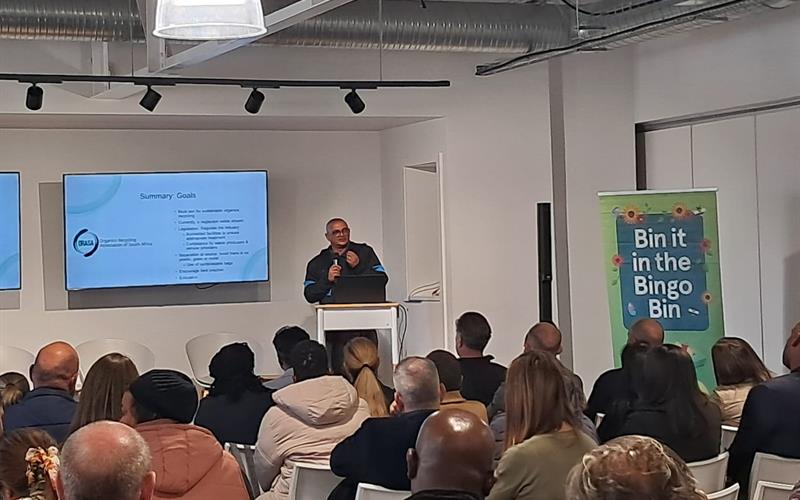 At the plenary, businesses were reminded that having a waste management plan is a legal requirement. The City encouraged all food and beverage companies to prepare and submit these waste management plans and to include clear strategies for reducing organic waste by 100% by 2027. These strategies could include:
- Separating organic waste from general waste in operations;
- Providing proper storage or on-site treatment for organic waste;
- Making use of off-take options, including:
o Selling food past its sell-by date but still within the best-before date
o Recovering surplus products
o Converting waste into animal feed
o Supplying waste to insect farms
o Producing biogas energy from waste
GreenCape provided guidance on these options for organic waste off-take during the session.
Furthermore, it was emphasised that businesses should ensure they only make use of private waste management services if they are accredited with the City. This helps ensure that waste is not mismanaged. Accreditation can be done online via the City’s website: capetown.gov.za/City-Connect/Register/Business-and-trade/Register-as-an-accredited-waste-services-provider.
The Consumer Goods Council of South Africa also presented its South African Food Loss and Waste Initiative at the session, which gives members access to a network of businesses working together to reduce food waste. Several major brands have already joined, and others are encouraged to do the same. Research shows that around 80% of food waste is still edible at the time it is thrown away – an alarming figure in a country facing high levels of poverty and hunger.
‘While upcoming restrictions on landfill disposal may pose operational challenges, reducing waste can lower business costs and even improve profitability. Landfill fees are expected to rise faster than inflation, so we want businesses to be ready.
‘There are already many innovative, scalable solutions available in Cape Town,’ added Alderman James Vos, Mayoral Committee Member for Economic Growth. We want to connect businesses with these service providers. Reducing organic waste is not just good for the environment—it also boosts operational efficiency and business resilience,’ said Alderman Grant Twigg, Mayoral Committee Member for Urban Waste Management.
Businesses that need support to update their waste management plans with organic waste reduction strategies can contact the City at: waste.accreditation@capetown.gov.za.
End
Published by:
Media Office, City of Cape Town